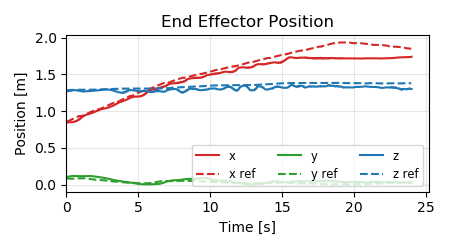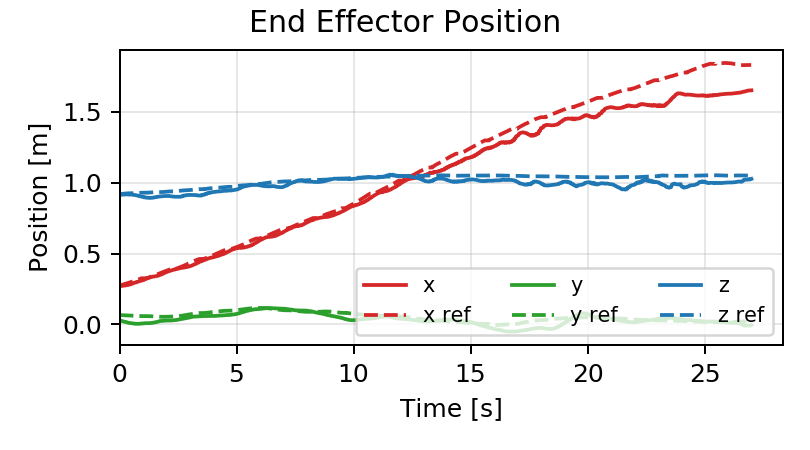
Aerial Manipulation in the Wild
Research Project, MoMA.v5 Workshop at IROS 2026, 2026
Bringing aerial manipulation outdoors with onboard state estimation, a learned end-effector policy, and coordinated whole-body control.
The challenge
Outdoor aerial manipulation must handle visual changes and disturbances while controlling both the flying base and manipulator. The system needs to estimate its state without external motion capture and execute precise end-effector motion.
Our approach
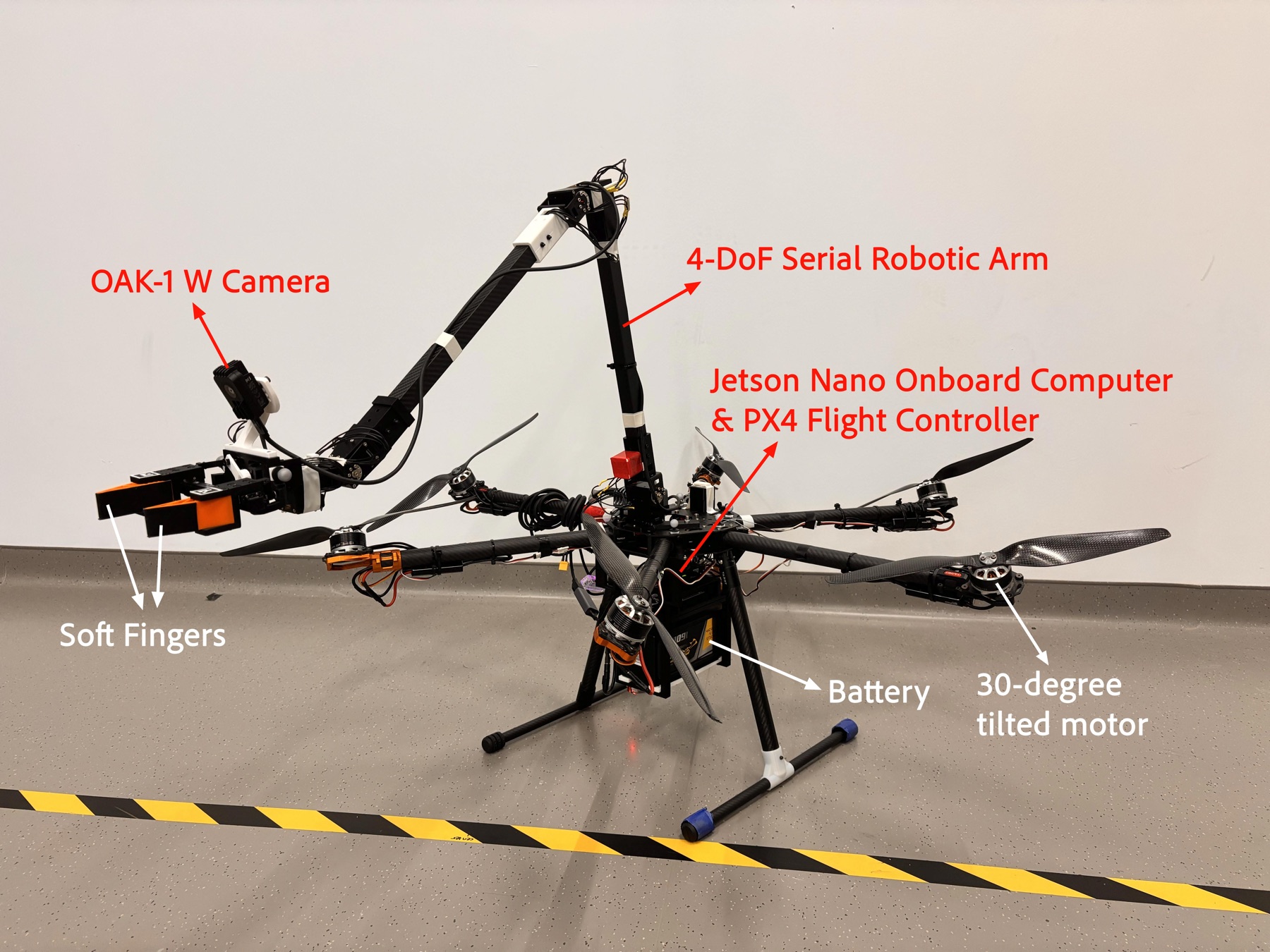
- Onboard perception: LiDAR–inertial odometry estimates the aerial base state during outdoor operation.
- Policy learning: A Diffusion Policy trained on 80 indoor handheld demonstrations produces end-effector motion commands from camera observations and robot state.
- Whole-body control: Model predictive control coordinates the aerial base and robotic arm to track the policy’s end-effector commands.
Outdoor demonstration
Results
The system completed all five reported indoor peg-in-hole trials and all three reported outdoor trials. The outdoor trials used the unchanged indoor-trained policy, onboard state estimation, and no motion capture or outdoor retraining. These initial outdoor results were obtained under mild wind and suitable lighting; broader conditions remain to be evaluated.