Learning-Based UAV Trajectory Planning
Research Project, Penn State University, 2024
A self-supervised UAV planning system that combines learning-based perception with physics-based optimization for interpretable and generalizable navigation.
The challenge
End-to-end planners can require large labeled datasets and may generalize poorly outside their training environments. Conventional optimization is more interpretable, but depends on a useful representation of obstacles and carefully selected trajectory timing.
Our approach
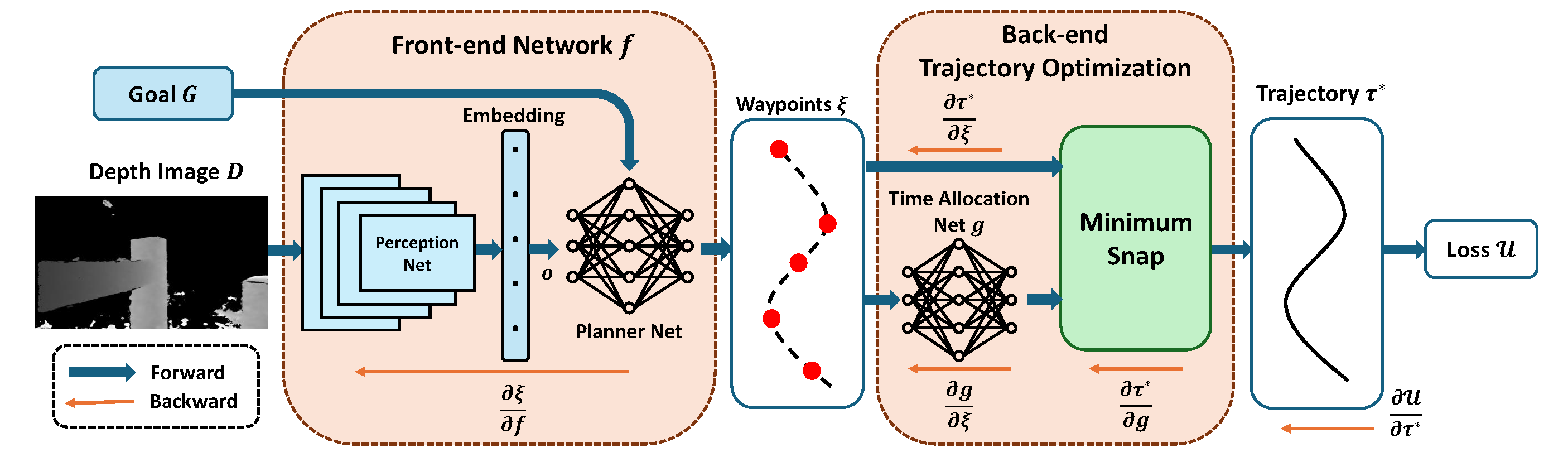
The system brings learning and optimization together:
- Self-supervised perception: depth observations are converted into a 3D cost map without expert demonstrations or human labels.
- Differentiable optimization: the network learns through the downstream trajectory objective while preserving physical constraints.
- Learned time allocation: a neural strategy improves both the efficiency and optimality of the generated trajectory.
Results
Simulation and real-world experiments showed robust navigation across varied environments. Compared with the state of the art, the method achieved a 31.33% improvement in position tracking error and a 49.37% reduction in control effort.